

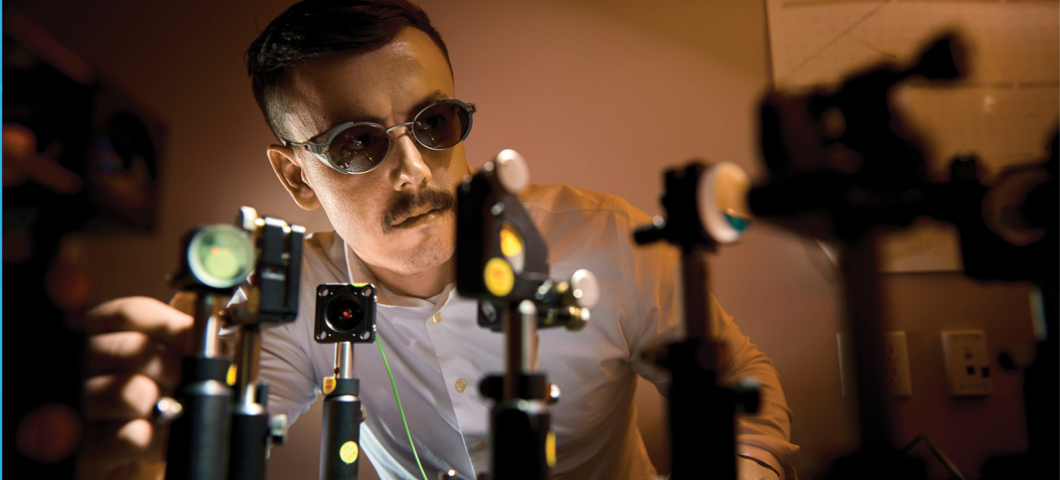

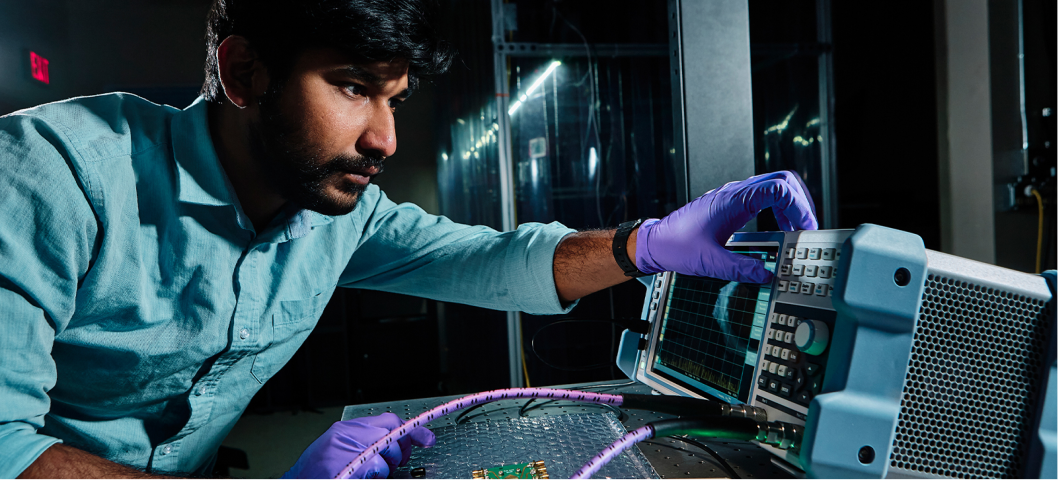
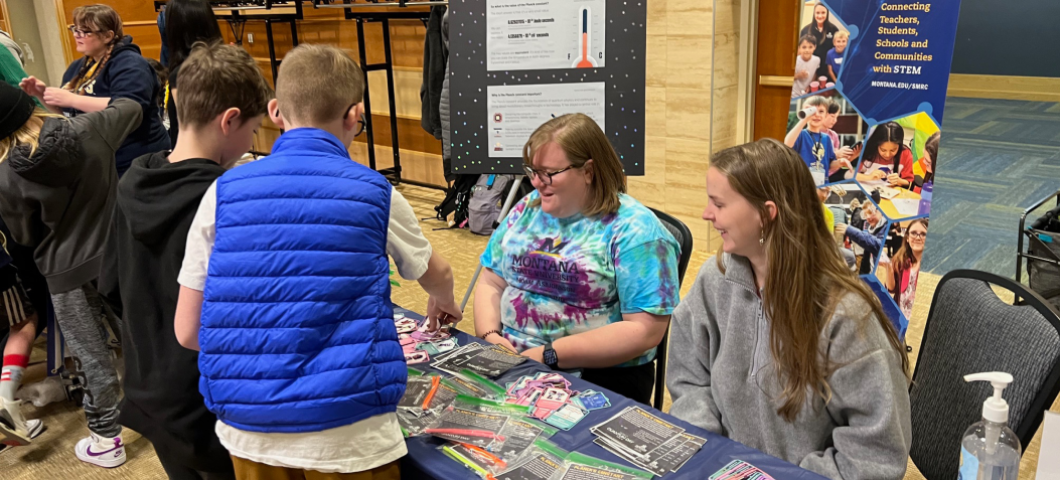
Montana State University QCORE has undertaken an ambitious research agenda with a focus on quantum computing, quantum communications and quantum sensing. Success in these fields relies on principles established in quantum physics such as entanglement, superposition and coherence. Technology based on these principles of quantum physics can lead to computation with exponential speedup over classical techniques for certain problems, provably secure communication, and higher precision sensors.
Join us for QCORE's Seminar Series
All are welcome to join QCORE's weekly Seminar Series, hosted each Wednesday afternoon at 4:10 pm at QCORE in EngineWorks, 2425 Technology Blvd. West, Bozeman. See upcoming and past talks and speaker affiliations below.
Upcoming
Wednesday, April 15, 2026 - 4pm - Josh Doherty
Low-noise cryogenic systems for Quantum
Quantum technologies are entering a new phase. What once lived in physics labs supported by ad hoc experimental setups and custom cryogenic systems is now moving toward deployable, real-world products. As this shift accelerates, the entire ecosystem must deliver more robust, repeatable, and low-noise system performance.
In this talk, I will discuss how Montana Instruments, now part of the Atlas Copco Scientific Vacuum Division, is supporting this transition. I will outline emerging approaches in system architecture, vibration isolation, vacuum performance, and low-noise I/O that enable the move from bespoke research tools to scalable quantum infrastructure. I will also highlight the growing need to expand system specifications for quantum applications. Establishing these benchmarks will require collaboration between quantum users, system manufacturers, and component providers to set industrial standards.
By approaching quantum enabling hardware as a full system engineering challenge and aligning on meaningful performance metrics, the industry can accelerate progress toward scalable and reliable quantum systems.
Josh Doherty
Josh Doherty, Ph.D. is a Montana native whose career has been rooted in deep‑tech innovation, spanning biomedical imaging, precision instrumentation, and most recently, quantum technologies. He leads the Research & Development team at Montana Instruments, now part of the Atlas Copco Scientific Vacuum Division, where he focuses on creating next‑generation cryogenic platforms engineered for low‑noise quantum research.
Wednesday, April 22, 4pm - Craig Ogilvie, Physics, and Suzi Taylor, Science Math Resource Center
Shaping the future of quantum education
Join the QCORE team to help shape the future of quantum education and outreach at MSU and across Montana. In this interactive session, input from faculty, students and other attendees will help identify gaps, opportunities, and priorities for strengthening quantum science and technologies education at MSU and workforce development in the state.
We’ll share an overview of the emerging quantum education and workforce ecosystem at MSU and highlight current and planned educational pathways spanning K–12 outreach around the state; two-year and four-year undergraduate programs; graduate education; and co-curricular opportunities such as internships, student organizations, and user groups. We will then solicit expertise and ideas from the audience to shape future programming, including potential executive and technical training programs for industry. Framed by the mission of QCORE, the talk emphasizes MSU’s role in expanding access to quantum technologies and developing a diverse quantum-ready workforce.
Craig Ogilvie
Dr Ogilvie is a Professor of Physics at Montana State University. Having served as Graduate Dean for 6 years, he conducts research in graduate student success. Recent external grants include an NSF Epscor Graduate Fellowship grant to support GRFP Honorable mention winners, a Bridge to the Doctorate grant to fund Indigenous STEM PhD students, a renewal of the Sloan grant with similar goals, and a NSF RAPID grant on the impact of the Covid-19 pandemic on graduate students across the country. Dr. Ogilvie has published over 300 papers with a h-index of 116.
Dr Ogilvie was born and raised in New Zealand, received his PhD at University of Birmingham, UK, and worked as a postdoc at Michigan State University, GSI Darmstadt, and held prior faculty positions at MIT and Iowa State University.
Suzi Taylor
Suzi Taylor is director of the Science Math Resource Center in MSU’s Department of Education and oversees QCORE’s K-12 Education and Workforce Development team. Suzi has a long history of leading outreach and engagement programs for Montana State University, including serving as Workforce Development lead for Montana NSF EPSCoR's statewide project, SMART FIRES, and partnering with faculty on grants funded by NASA, USDA, the Department of Energy and other agencies to create programs that support the citizens of Montana. Suzi also serves as executive director of the Montana Science Teachers Association and as co-leader of the Montana Girls STEM Collaborative, a statewide network of adults who collaborate to engage and inspire girls and young women in STEM.
Wednesday, April 29, 4pm - Prasanta Bandyopadhyay, Philosophy
Past
Wednesday, April 8, 2026 - 4pm - Josh Aller, AdvR
Quantum Enabling Waveguide-Based Components in Bozeman, MT
Abstract: AdvR, Inc. is an engineered nonlinear optics company in Bozeman, MT, focusing on the design, fabrication, and characterization of waveguide-based components. These components are used in a variety of quantum computing, quantum networking, and quantum sensing applications for electro-optic modulation, frequency conversion, and photon pair production. This talk will focus on active areas of R&D at AdvR and how those developments enable new advancements in quantum and quantum adjacent fields.
Josh Aller
Josh Aller is the Chief Technology Officer at AdvR Inc. working on the development and commercialization of waveguide-based components. He has been with AdvR since 2016 and is an MSU graduate from the College of Engineering. At AdvR, he works with a team of experts developing these photonic components for unique applications.
Wednesday, April 1, 2026 - 4pm - Mark Craig, Gallatin College
“Classical” Computing – How Silicon Scaling has Reached 2nm!
Mark Craig
Mark’s expertise is in microelectronics fabrication technology and device physics. Over nearly two decades in the semiconductor industry he worked on technical tasks ranging from FEOL process module development, thin film stress techniques for device enhancement, technology design rules, SRAM bitcell design, test structure and mask design, yield enhancement, and design-for-manufacturability (DFM) techniques. He managed engineering teams supporting a range of technologies from 0.4 um BiCMOS to 20 nm FinFET technology nodes. During his career, Mark worked at Motorola’s Advanced Products R&D Laboratory, TestChip Technologies (later acquired by Synopsys), and AMD/Global Foundries.
Wednesday, March 11, 2026 - 4pm at QCORE - Eric Grumstrup, Chemistry and Biochemistry
Single particle spectroscopy of emerging functional nanomaterials
Single particle spectroscopies are essential for establishing the fundamental structure- function relationship of nanoscale materials as well as design principles for the emerging technologies that rely on them. Ongoing research in my group focuses on the development and use of spatially-resolved optical techniques to characterize electronic structure in a range of condensed phase systems where conventional “ensemble” techniques fail. I’ll discuss recent efforts to develop higher sensitivity and/or broadband, femtosecond microscopies that provide unprecedented insight into polymorphism and its functional impact in organic semiconductors. I’ll also discuss emerging work that aims to develop mixed-dimensional heterostructures between molecular, single photon emitters and 2-dimensional transition metal dichalcogenides.
Erik Grumstrup
Erik Grumstrup is a professor of Chemistry and Biochemistry and an affiliate of the Materials Science and Engineering Program at MSU. Before joining MSU in 2014, he was an NRC postdoc with the ARL and UNC Chapel Hill.
Wednesday, March 4, 2025 - 4pm at QCORE - Magali Eaton, MSU Technology Transfer Office / QCORE
Quantum Innovation: Translating Research Into Impact
The goal of this conversation will be to spark ideas around how one can be successful at taking their research results to societal impact. There are myriad ways to do this, depending on what one's individual goals are as well as who might be the beneficiaries of the work. Let's tackle all questions big and small, from why doing this in the first place, to how this gets funded, to who is involved in taking things to impact, to how to get this done amid everything that we all have going on. Let's also touch on what's special about translating quantum innovations. Come learn about exciting ways to position your research for translation and to turn the results of your research into long-lived societal impact!
Wednesday, Feb. 25, 2026 - 4pm at QCORE - Dr. Sam Gunningham, Mathematics
An Introduction to Quantum Topology
Mathematician’s have long been interested in the study of knots and links in 3-dimensional space. Pioneering work of Jones, Witten, Reshetikhin, Turaev, and others in the 1980s and 90s completely transformed the field, introducing new tools and ideas inspired by quantum physics. This has led to a remarkably fruitful interchange of ideas between mathematics (e.g. lowdimensional topology and representation theory) and physics (e.g. condensed matter and quantum computing). I will aim to give a gentle introduction to the subject from a mathematician's point of view.
Dr. Gunningham’s work is broadly in the Geometric Representation Theory, drawing on ideas from geometry, topology, mathematical physics, and related fields. Many of the phenomena he studies can be viewed through topological field theory (TFT). In physics, TFTs arise from quantum field theories that do not depend on the spacetime metric, often after a suitable twist or limit. Mathematically, a TFT assigns numerical and linear algebraic data to manifolds. Dualities predicted by physics, particularly string theory, therefore lead to concrete mathematical predictions that can be precisely formulated and proved.
QCORE in the News
Montana State University Launches QCORE Facility, Installs Rigetti Novera Quantum Computer
MITRE and MSU Collaborate to Accelerate Advances in Rare Earth Minerals to Fuel Quantum Research
More From MSU News Service