

Two Polarizers Activity
Two Polarizers Activity Downloadable PDF (full text below)
Overview:
In this activity, students explore how light can be polarized and how polarizers can be used to control the passage of light. By observing different light sources and using one or two polarizing filters, students will discover that some light sources are already polarized. The activity ends with a simple communication challenge that introduces ideas from quantum information and secure messaging.
Materials:
- Polarizing slides (2)
- Computer screen (not provided), or phone/iPad screen
Preparation:
Be sure you have a computer screen accessible where students can see it. Test out the activity before students are present to make sure you know what to expect.
Directions:
Step 1:
- Give students one polarizer and have them look at different light sources such as overhead lights, light coming in the window, light from a computer screen or phone screen. Encourage students to turn the polarizer at different angles while observing different light sources. As a group, discuss what they notice and what they wonder.
- Students will likely have observed a few different things:
- Looking through the polarizer makes some lights dimmer (like how sunglasses make light dimmer).
- How dim the light appears may change depending upon how the polarizer is rotated.
- Some light sources (like computer and phone screens) may be entirely blacked out when the polarizer is rotated at certain angles.
- A polarizer is a film of plastic containing many tiny slits. These slits are either oriented vertically or horizontally.
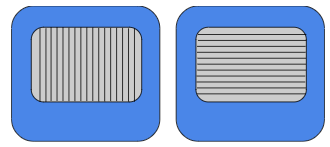
Polarizers only allow light that travels in a certain direction to pass through (see more details below). For example, polarized sunglasses work to block some of the sunlight that reaches your eyes.
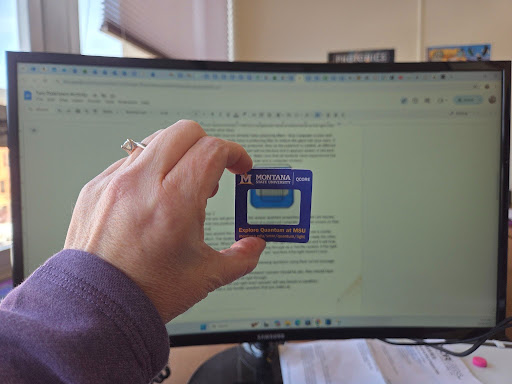
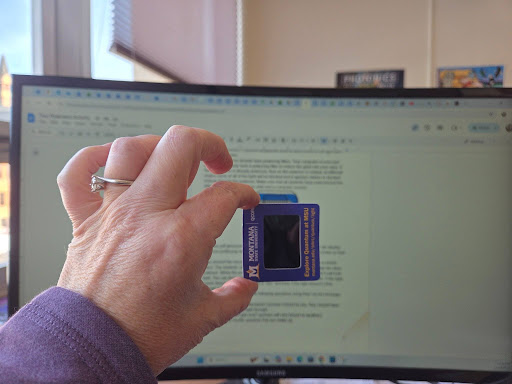
- Some light sources already have polarizing filters. Your computer screen likely has a polarizing filter to reduce the glare into your eyes. If the light source is already polarized, then as the polarizer is rotated, at different angles some or all of the light will be blocked and it appears darker or blocked entirely through the polarizer. Make sure that all students have experienced the effects of the polarizer and polarized light source (computer screen).
Step 2:
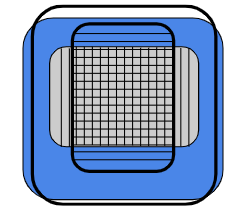
- Introduce the second polarizer. It is exactly the same as the first. The students should hold one polarizer straight and then rotate the other polarizer. When the polarizers are crossed at 90° the light will be blocked and it will look dark. When two polarizers are crossed, the tiny slits block light in two directions, and no light is able to pass through. Let the students experience this phenomena.
- Now you will demonstrate the unique quantum properties that light can display with polarizers. Hold one polarizing slide in front of a polarized computer screen. Turn it so that the light is blocked. This is due to the combination of the polarizing slide, and the polarized screen.
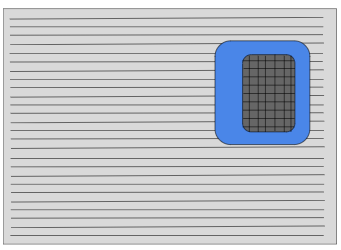
- Ask students what they think will happen if a third polarizer is inserted between the slide and the screen (a third polarizer is inserted between the other two polarizers and the light source)?

- Try it!
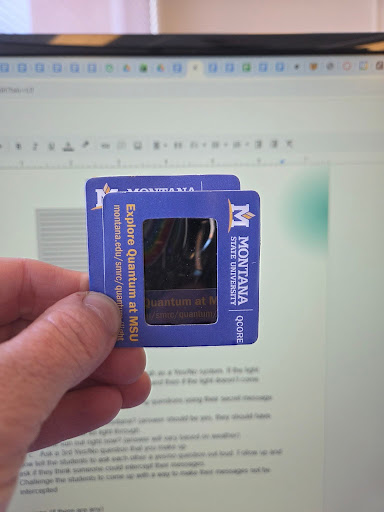
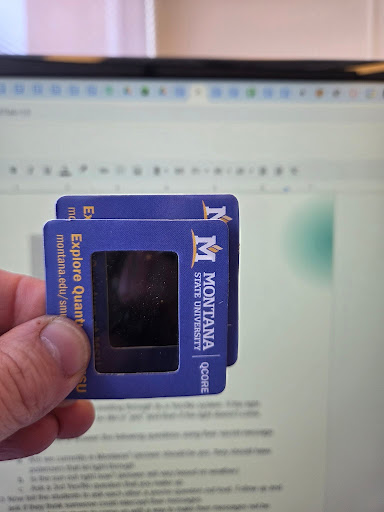
When the middle polarizer is inserted the same orientation or 90 degrees from the first polarizer, no light passes through.
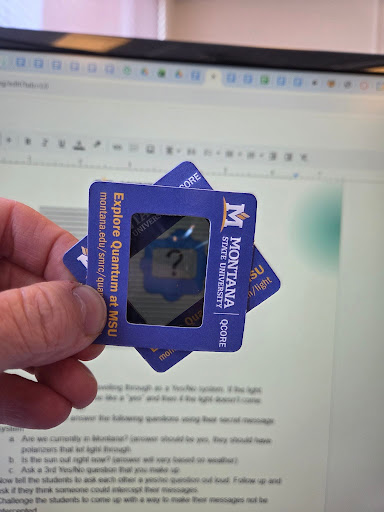
However, when the middle polarizer is oriented at 45 degrees, the screen can be seen again!
This phenomena occurs due to the quantum nature of light. See Explaining the Science below for a full explanation.
Extensions
-
You can use polarizers and light as a method to communicate information. Light travelling through the polarizer (or not) can represent a Yes/No system. Light coming through represents a “yes” and blocked light indicates a “no.”
-
Choose a volunteer to answer some trivia questions using the two polarizing slides. Instead of verbally answering yes or no to your questions, they will use the polarizers and system defined in step one to communicate their answers. Ask the student to answer the following questions using their secret message system:
-
Are we currently in Montana (or whichever state you are in)? (answer should be yes, they should have polarizers that let light through.
-
Is the sun out right now? (answer will vary based on weather)
-
Ask a 3rd Yes/No question that you make up.
-
Now call on other students to ask an appropriate yes/no question out loud.
-
Ask students to think about this: with this form of communication, could someone intercept their messages?
-
Challenge the students to come up with a way to make their messages not be intercepted.
Explaining the science:
Light is a wave that moves in every direction (up-and-down and side-to-side) as it travels. An easy way to think about this is that light can move like a shark tail (side to side), or a mermaid tail (up and down). Most everyday light sources produce unpolarized light, meaning the light waves vibrate in many different directions. A polarizer is a filter that only allows light vibrating in one specific direction to pass through.

When unpolarized light passes through one polarizer, some of the light is blocked and the light becomes dimmer. Only the light waves that are moving in the same direction as the slits in the polarizing film can come through.
As explored in the activity, some light sources, like computer screens, already have a polarizing filter, which is why rotating a polarizer in front of them can make the screen appear darker or block all the light.
When light passes through two polarizers, the amount of light that gets through depends on their orientation. If the polarizers are aligned, light passes through. If they are rotated 90° relative to each other, the light is blocked. This allows polarizers to act like a yes/no (1/0) system.
At the quantum level, light is made of particles called photons, and each photon has a polarization. Polarization can be used to encode information in photons, which is important for technologies like quantum communication and secure messaging.
Use of Photons in Quantum Computing (From Quantime New Mexico)
The computers we use every day encode information using 0’s and 1’s. Maybe you’ve seen pictures like this…
01101000 01100101 01101100 01101100 01101111 00100000 01110011 01110100 01110101 01100100 01100101 01101110 01110100 01110011 00100000 01110111 01100101 01101100 01100011 01101111 01101101 01100101
(Decoded message: “hello students welcome ” using https://www.rapidtables.com/convert/number/ascii-to-binary.html)
You can think of computers as a series of switches, all being either off (0) or on (1). Quantum computing also uses 0’s and 1’s, but our switches are some of the smallest things in nature, like electrons, atoms, and photons (single particles of light). Instead of our quantum switches only being off or on, they can exist in special states that are both off and on, kind of like being in the middle of off and on. This special state is called a superposition. Some scientists and companies are building quantum computers with single particles of polarized light, where horizontal polarized light is 0 and vertical polarized light is 1. We can create a superposition of horizontal and vertical polarized light with diagonal polarized light.
|
Horizontal (aka 0) |
Vertical (aka 1) |
Diagonal (aka 0 and 1) |
|
↔ |
↕ |
⤢ |
Technically, in quantum computers the photons (single packets of light) are in the diagonal state, or in “superposition.” While this activity does not fully simulate superposition, it models how polarization can be used to encode and read information.
Polarization is also important in quantum communication, where measuring light in the wrong polarization can disturb the message. This makes it possible to detect eavesdropping and is a key idea behind quantum encryption.
Standard Alignment:
|
Standard Code |
Standard Text |
How does this activity support this standard? |
|
4-PS4-2. |
Develop a model to describe that light reflecting from objects and entering the eye allows objects to be seen. |
This activity supports this standard by helping students observe that light must enter the eye in order to be seen. By rotating polarizers and observing changes in brightness, students model how controlling the passage of light affects what is visible. |
|
4-PS4-3. |
Generate and compare multiple solutions that use patterns to transfer information. |
This activity supports this standard by allowing students to create and use simple on/off light patterns to transfer information. By using polarizers as a yes/no system, students explore how patterns of light can encode and communicate messages. |
|
MS-PS4-2. |
Develop and use a model to describe that waves are reflected, absorbed, or transmitted through various materials. |
This activity supports this standard by demonstrating how polarizers can transmit light partially or not at all based on orientation to the waves of light. |
This resource was provided by the MSU Science Math Resource Center using resources from the MSU Applied Quantum CORE funded by the Air Force Office of Scientific Research. The work was borrowed from a Polarization activity from Quantime New Mexico, https://www.quantimenm.org
412 Reid Hall • smrc@montana.edu