

Faculty Mentoring Program
For Tenure-Track and Non-Tenure-Track Faculty at all levels.
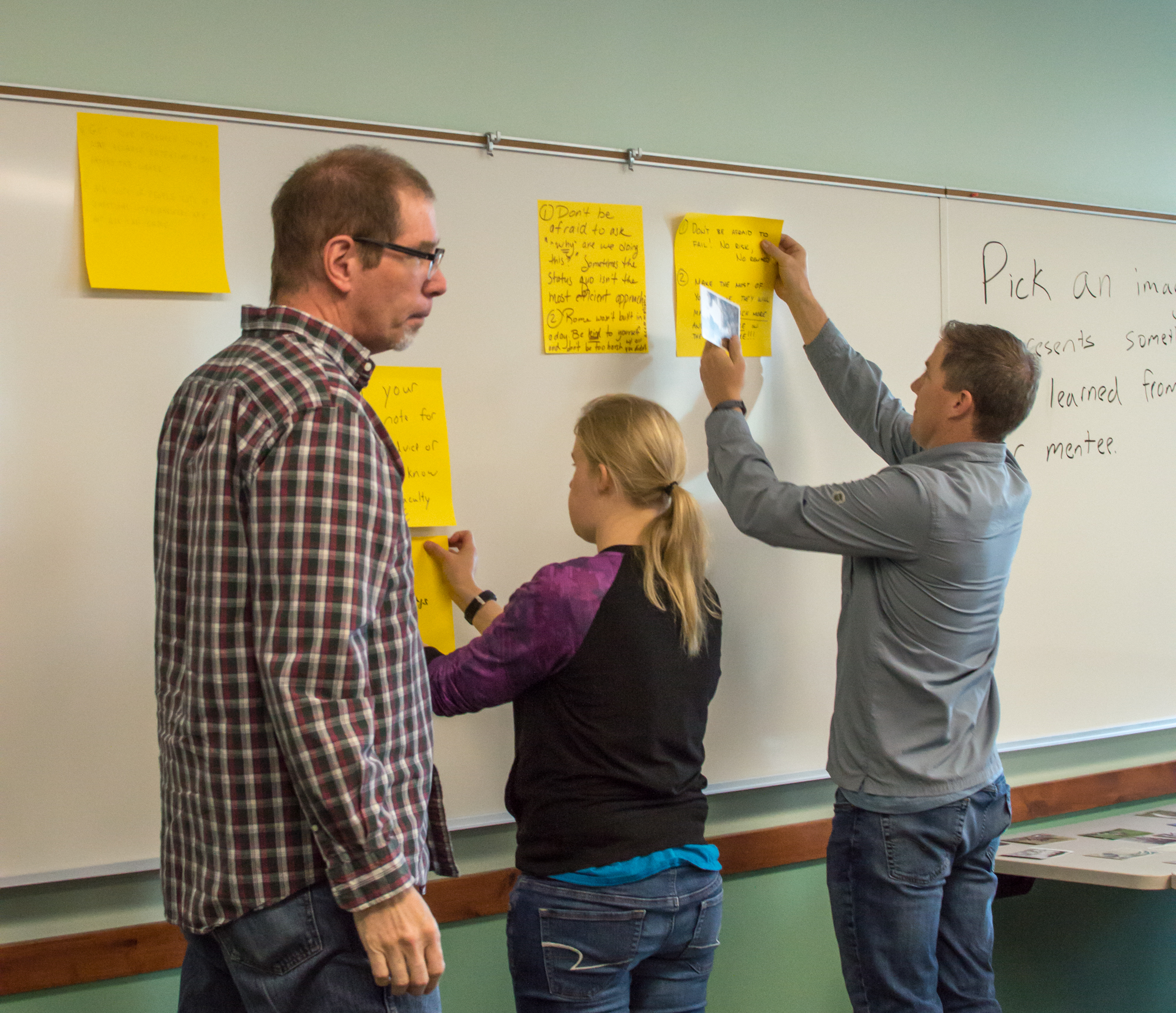 The CFE seeks to cultivate the spirit of collegiality by focusing our vision of mentorship
on MSU’s spirit of community, collaboration, and leadership made possible by connecting
colleagues and providing support and guidance throughout their careers.
The CFE seeks to cultivate the spirit of collegiality by focusing our vision of mentorship
on MSU’s spirit of community, collaboration, and leadership made possible by connecting
colleagues and providing support and guidance throughout their careers.
Our goal is to create a community who supports our mission of integrating a spirit of belonging, education, creation of knowledge and art and service to communities.
Feedback from participants:
"I have been pleased with how well the Mentorship Cluster model works because of our disciplinary contrasts. I also think having two new faculty to one more experienced one helps manage the power dynamic that can be icky in one-on-one mentoring."
"The marvelous mix of experiences makes it substantially easier for all of us to be mentored and mentors. As a more experienced faculty in our triad, I've learned quite a bit from triangulating our various approaches and problems needing solving. I like the Mentorship Cluster design even more than I expected to. It's rejuvenating."
Objectives
- Build a welcoming and inclusive culture that spreads into classroom, research, creative and community spaces
- Equip faculty with the knowledge of how to promote their successes through
- Promoting student success
- Taking advantage of student support services
- Becoming part of a network of mentors
- Participating in professional development and training
- Seeking internal and external grants to support education, research and creativity
- Help new faculty become part of the MSU community and develop their mentor network
- Help Tenure-Track Faculty understand expectations around retention, tenure and promotion
Invitations to participate are sent to new faculty after they have registered for new faculty orientation. For questions, reach out to cfe@montana.edu.
According to research on faculty mentoring, early career faculty or mentees benefit from:
- Increased productivity, including more publications, more NSF or NIH grants, and an increased likelihood of publishing in a top-tier journal (Blau et al. 2010; Carr et al. 2003)
- Enhanced tenure and promotion prospects (Johnson 2007; Kosoko-Lasaki et al. 2006; Stanley & Lincoln 2005)
- Increased sense of support for their research (Carr et al. 2003)
- Heightened teaching effectiveness (Luna & Cullen 1995)
- Higher career satisfaction (Carr et al. 2003)
- Lower feelings of isolation (Carr et al. 2003; Christman 2003; National Academy of Sciences 1997)
- Greater sense of fit – especially for women and faculty of color – which has been shown to be critical to job satisfaction and retention (Trower 2012)
The Center for Faculty Excellence recruits mentors from within the early career faculty’s department to receive advice and guidance specific to promotion and tenure requirements and from across colleges to gain different perspectives and experiences. Matches between mentees and mentors are made based on similar teaching, research, and service appointments.
Mentors can help early career faculty excel in meeting their goals and navigate expectations, requirements, and challenges. Mentors offer advice and guidance on:
- Goal Setting
- Teaching
- Research
- Promotion and Tenure Requirements
- Increasing visibility of accomplishments in teaching, research, and service
- MSU Culture
- Work/Life Balance
- Living in Bozeman
Mentors have even conducted classroom observations to provide feedback and reviewed manuscripts for their matches.
The matches will be expected to meet one-on-one two times during the fall semester and three times in spring semester, including a goal setting exercise. Other meetings are at the discretion of the mentors and mentees. Several optional mentor program group meetings are scheduled on a variety of topics throughout the year.